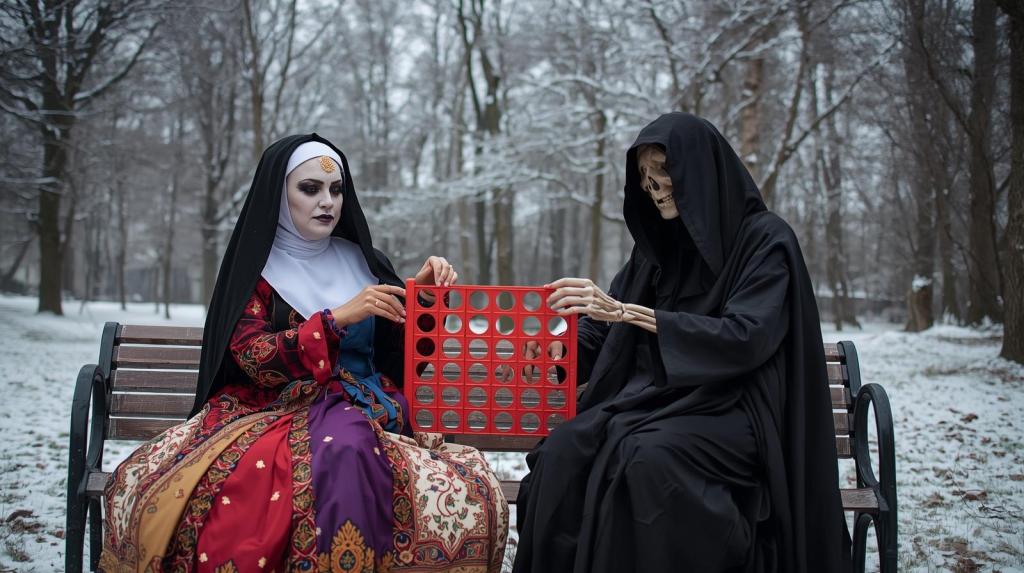
As humans living in the modern world, we are almost always unaware that we live our entire lives in the shadow of death. We are a delicate species. Easily killed. If we are exposed to too much heat or too much cold – we die. If we go too long without food or without water – we die. If we are struck too hard, or fall from too great a height – we die. If we eat the wrong food, or get stung or bitten by the wrong animal – we die. If we get sick with the wrong bacteria or virus – we die. If we take the wrong dosage or type of medication – we die. If our nation goes to war and we are called to serve or if we go to school with angry, vindictive schoolmates – we die. If we spend our lives in poverty and have inadequate access to the bare necessities for a decent, dignified life – we die. But we spend our lives entertaining ourselves with nonsense. Who’s in or who’s out. What’s in or what’s out. Gossip. Other people’s problems. Other people’s private lives. Other people. Anything to distract us from our own mortality. I am not without understanding, as I am as culpable as any other.
In early October, my mother fell in her bathroom while brushing her teeth and was taken by ambulance to the hospital. I turned to my husband on the couch next to me and said simply, “This is it.”
My mother has been sick for quite some time. First, shattering her shoulder after an unfortunate fall eleven years ago. Then being diagnosed with stage-2 lung cancer and undergoing a lobectomy and remedial chemotherapy nine years ago. We had been anticipating celebrating the “all-clear” from her oncologist indicating that they had successfully cured her cancer when she began experiencing unusual symptoms three years ago. It started with vision changes, then word-finding problems, and then finally personality changes. Having had years of untreated anxiety and depression, all of her doctors and her family thought that this was a mental health problem. But as she got worse, her oncologist sent her for a CT scan where they found a new tumor that had been growing in the left hemisphere of her brain. This was a return of her metastatic lung cancer. Her all-clear would have to wait.
I never knew that. I never knew that when you have cancer of your lungs or your skin and it metastases in another part of your body, like your brain, you don’t have brain cancer, you have actual mutated lung cells growing in your brain. Yet another unique way life tries to kill us. My mother had lung cells growing in her brain and they did not belong there, so we had a world-class neurosurgeon remove the mass and a radio-oncologist treat the affected area with gamma-knife radiation. She came out of both in great shape and returned to her life with monthly MRIs to monitor any return of the cancer. She was stable for an entire year until a new mass was noted near the same place as her prior growth. So, the same treatment was recommended by all of her doctors and we proceeded with that treatment.
But this time was different. This time something wasn’t right. When she came out of her anesthetic haze, she showed significant cognitive decline. She didn’t know where she was, or why she was there. She became confused, depressed and -rightfully so- more angry. We were told that this would get better over time and when it didn’t, I immediately arranged for neurocognitive rehabilitation. While this did not get her back completely, it got her back mostly. Yet, she still slowly continued to decline. Thanksgiving 2024 she wandered to the neighbor’s house after cutting her foot. And that Christmas, my brother woke up to find my mother smiling broadly, sitting in her favorite chair with her hair and make-up done but wearing nothing more than her bra and summer-weight pajama bottoms. She was rushed to the hospital with a legitimate fear that she had had a stroke. But her CT scans were all clear. Nothing was wrong.
A psychiatrist sat down with us and suggested that she would likely need to be placed in a memory-care facility or another home that would be able to care for her. But I refused to believe that we were there yet. Her neuropsychologist agreed with me and she continued in neurocognitive rehab and she again improved. We still had a very nice Christmas. I wish I had known it was going to likely be the last normal holiday I would experience.
She was able to spend another spring and summer out of a nursing home, gardening and drawing as she had always loved. Her yard was even slated to be on the city garden walk, something she was so excited about and had worked so hard to achieve. We had planned on coming into town in August to help her host the hundreds of people who would be touring her yard. But then she began complaining of increased fatigue and had to remove her yard from the tour. It broke her heart. In September, she began experiencing numbness and tingling in her right hand and again went to the hospital with no indication for the loss of function apparent. A month later she was in the hospital and a month after that, a resident of a nursing home where my family spent our first Thanksgiving with her as a patient.
So this Christmas, I got the wonderful gift of making the decision of how to proceed with treatment. Do I opt for more surgery, radiation and chemo that could leave her sicker and subtract from whatever time she has left with her family, or do I seek mercy and bring in hospice so that her final months can be as happy and fulfilled as possible? Life is a cruel master. I live 300-miles away and cannot rush to her bedside to have these difficult conversations with her. When I have brought the issue up, as a hypothetical, she shut down and refused to speak about what she would want when her treatment options have run out. How would I respond? I would any of us respond if our loved one came to us and said, “By the way, if you should happen to find yourself dying, how would you like us to manage your care? And what do you think of cherry wood for your casket?”
Yet living in the valley of the shadow of death during the season of light has been less difficult than one might imagine. I have discovered that most people are terrified of death and even more terrified to discuss it, like ignoring the subject somehow prolongs one’s life. I have determined that I cannot approach death that way – not my own and not my mother’s. Death is not something we should fear, at least not in the way that we do. Death is as necessary and as miraculous and -dare I say it – as wonderful as birth. For births, we hold gender reveal parties, showers, and annual birthday parties filled with cake, and presents and a bizarre song that nobody likes yet we all continue to sing. For deaths, we try and ignore them. We speak in hushed tones. We avoid the topic. There is no cake. No creepy songs. No discounts at Texas Roadhouse. The difference, between birth and death is a negligible one. Death is the required antecedent to birth. One cannot be born unless somewhere, someone else dies. Death is life’s fuel. Nothing in existence today could be there without the death of something else. Trees depend on death and decay to nourish enormous root systems. Mushrooms thrive on death. Even a mountain range is there because what had been a flat continent had to give way for an out of control plate ramming into the side of it.
Our own lives begin with death. Two totally independent, living cells, combine, die and become something else entirely – namely – you…or your kid, or a niece. But what of death? What does it mean to die? What exactly is that process and what happens when that process is over? Science, for all that it can explain, cannot precisely explain what happens when we die. I’m not talking about the failing of our heart, or the dying of our brain. I mean what truly happens to us, the real us. The fact is that science does not know. Faith has moved in with what it believes is an answer. But even this, I think, falls desperately short of what truly is to come. We live in what appears to be a limitless universe. We are human and perceive very little of what there actually is. Do you think a universe as enormous, unfathomable and mysterious as the one that we inhabit, would just snuff out its own consciousness? As human-centric as this might sound, we ARE the reason that the universe exists. For without a created consciousness, the universe would be unaware of its own existence.
I am a Catholic, albeit a heretical one, but a Catholic nonetheless. When Moses asks God what His name is, God responds with “I Am that I Am.” Most people view the Bible as complete fiction, and frankly, a lot of it is. But that answer is beguiling. “I Am that I Am.” God then is what it means “to be.” God is existence and the answer to why there is something rather than nothing. So for me, as a Catholic, the mystery of the incarnation, which we only just celebrated, is not a mystery at all. Fr. Richard Rohr said that God becomes things that he loves. And this means humans as much as a star or an atom of helium, or a redwood.
I am not afraid of death. If I am right, and we, in some manner or effect, go on into whatever comes next, and the process of physical death is merely a transformation, like the shedding of a chrysalis, then what an exciting time that will be. But if I am wrong, it won’t matter. I will become a part of the limitless and rejoin the earth, and all of creation as an indistinct part of it all. In one instance, I am still aware of my contribution to the miraculous, and in the other, I simply am not. When my mother dies, and she will, like us all, she will either be released from her shell into what comes next or will become a part of the world she so dearly loved. Either way, she wins. Either way, we do too.
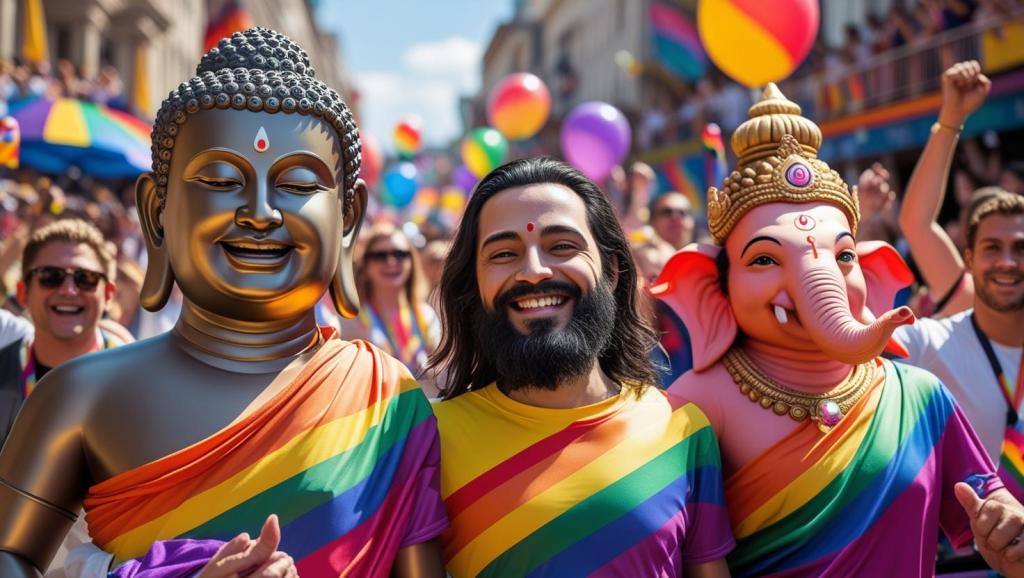
Christians and Christianity have gotten a bad reputation in the last several…thousand years. And with good reason! From the frightening Crusades of the Middle Ages that brought with them pestilence and death (and apparently cinnamon and pepper…how gay were the Crusades?) to the most recent walking Christian carbuncle, Kim Davis the four-time married, hillbilly hooker from Kentucky who is now bringing a challenge to gay marriage because her legal fees have forced her to sell off her entire Beanie baby collection and her momma’s Elvis memorabilia. Christians deserve their bad rap. The fact is that there are among the Christian world those of us who think and feel differently…about all of it.
I am a gay Catholic. Openly. Without apologies to the gays or to the Catholics. Despite my faith, I am also not what one might call traditional or conservative. Some might call me a “cafeteria Catholic” – one who likes to pick and choose from a buffet of beliefs which ones they will follow and which they will pass on. I don’t see that as an insult. If that means that I choose to use the good sense God gave me as a reasoning and logical creature rather than blindly follow a group of fussy old men in dresses and custom millinery over the precipice? Fine. However, I do choose to follow those teachings that: 1) make at least a little sense to me, and 2) do not negate, in any way, the Jesus of the Gospels. Some might even call me a heretic. I like that word. It’s not one heard much anymore. (Like “facts” or “hypocrite” or “Nazi sympathizer”)
Conservative Christians have polluted the faith in a way that should, to a sensible person, shock them. They have taken a brown man from the Middle East who taught as his central teaching to love your neighbor as you would love yourself and turned him into a fusion of WWE wrestling, a monster truck rally, a 4th of July fireworks display and a gun show. And these people have no shame in it. They produce men like Pete Hegseth who do not bat an eye when they use religion as a club to beat down gay people or, as of lately, women. Or J.D. Vance who twists the words of Christ to fit the putrid narrative emanating from America’s Hitler. Then there is the cowardice of the supposed Christian Right. They would rather pander to a power hungry, megalomaniac in a full diaper than put the breaks on it all and stand up for real Christian principles. These include compassion, kindness, understanding, generosity and hospitality. You cannot go to your megachurch’s bake sale and praise Jesus on Sunday and then send your fellow humans to a concentration camp or take away their basic rights the next and still call yourself a Christian. There is nothing Christian or divine about cruelty, or oppression.
I am, like every human born before and after me, a sinner. Sin is a word that has become synonymous with judgment and condemnation. Like nobody ever has made a mistake before. Sin is used in a strange way by Christians who I believe may have forgotten what that word really entails. It is not saying “shit, or fuck or damn.” It is not drinking too much at a party. It isn’t being gay. It isn’t baking a cake for a lesbian wedding. To sin is to ignore our relationship with creation. When we imprison someone for being gay, or discriminate against them for being trans, or black or Puerto Rican or judge someone…for any reason…that is sinning. To sin is to clear cut a forest for cattle grazing, or cause a wildfire in order to have a gender reveal party, or to pollute the air and water for profit. Sin is to cause offense to God and to others by forgetting them and doing whatever we want. At its root, sin is selfishness, cowardice and hubris all rolled into one.
Sin is a wound. But if we know anything at all about the Jesus from the Gospels, he really enjoyed healing people. Those wounds only drew him closer to the people. When we call to mind our shortcomings and our moments of failure, even our moments of darkness, it does not need to be shameful or painful. It is when we bring these dark gifts to God that he delights the most. Recognizing our failure and endeavoring to do better is at the root of what real Christianity is all about. Redemption is not some end times ticket to heaven. It happens right now. When we say we’re sorry for doing something thoughtless and then make up for it, that is redemption. When we make billions of dollars from the poor but then seek to give it all back in ways that augment their lives, that is redemption. I ask God not just for forgiveness, because he gives that willingly and at all times and for all things. I ask him for the strength to bear it all. I ask for wisdom. Sometimes I ask to just keep my head above water.
Noticing that you are in the presence of God should be something one constantly tries to do because whether you take note of it or not, you are always in his presence. Churches. Temples. The Holy Land, Mecca. Bodh Gaya. Varanasi. Rome. All holy places. All places where God’s presence dwells. But none of these places have more or less presence than where you are right now. Your shower. Your bed. Your favorite chair. Your least favorite chair. The bus stop. Your doctor’s waiting room. On the toilet. In a park. In your office. Each of these places also hold within them the entirety of God’s presence. The difference between St. Peter’s Basilica and your bathroom-aside from several billion dollars worth of priceless art and architecture and the fact that you can’t roam around St. Peters naked- is the perception that it is holier. But God is not more or less present in either place. While a beautiful church, temple, synagogue, or mosque might more easily invite prayer and meditation, they are not more full of God. To deny that is to negate the very nature of God.
The seasons are reminders of the awesomeness of God. Not awesome like in an old Keanu Reeves’ movie but rather “full of awe.” The wisdom present and on full display for anyone to witness during these times of year truly reminds me that existence itself is the greatest miracle. Trees during springtime know precisely when to flower and bud. Birds know the right day to start their migration. Bees know when to stretch their little wings, do some dusting in the hive and get back to work. Animals know when to come out of hibernation. No one reminds them. They don’t get a text alert. In the summer, these creatures all continue in the vein of the miraculous. Just glance at any leaf- really, any leaf. And the workings of just that one leaf should silence you in amazement and gratitude. And that’s just the one leaf.
I once had an astronomy professor who told our class that, “There is no way to know how many universes have existed before this one and no way to know how many more will come after it.” The miracle of this universe unfolds before us in every moment of our lives. “The Kingdom of God is spread upon the earth yet people do not see it.” (The Gospel of Thomas). Instead, we see commodities. We see money. We see opportunities to sell crap. We see QVC and Facebook Marketplace. When we have re-learned the sacredness of all things, maybe then we might feel and witness the presence of God everywhere again and not constantly demand signs and wonders.
As a gay Catholic, the reclamation of Christianity for the sacred, for the contemplative, for the meditative, for compassion, for Christ, is an endeavor that is possibly a losing one. But God takes great delight in his little ones and it is in the underdog, the true David’s of this world, where the glory of God is made manifest. The Beatitudes, Christ’s message to the exhausted people of the 1st century begin with happy are the poor and continue with a litany of weakness as the dwelling place of true blessedness. Christ is not present in the rich. He is not present in the powerful. He is not present in the oppressor. He is not present in the bigot. He is not present in the violent. Christ is present in the smallest of people and in the tiniest of spaces. And always where one least expects him.
Shortly after the 2024 election, I found myself in Midway Airport in Chicago. I noticed something unusual, particularly for the liberal bubble that is Chicago. Milling about were a number of people sporting prominent and conspicuous Christian merch. There were t-shirts with giant crosses or just “Jesus Saves” emblazoned across them. I saw all manner of cross pendants -some in gold, or others covered in rhinestones. Parents, many of whom are dead set against their children becoming recruited or groomed by drag queens reading The Wizard of Oz to their kids at a public library, had dressed their own progeny in the same, blasphemous, way. They carried tote bags covered in the name of the Lord or bedazzled with yet again more crosses. One asks oneself where all of this stuff came from and who is making money from it, because I would be genuinely surprised if Tiffany at the mall kiosk where these people bought these insipid wares was running a charity shop.
In those weeks both leading up to and immediately after the election, the newly triumphant right began its victory tour. With not only the newly “liberated” Christians running amuck but with their Congressional leadership introducing all manner of religious legislative claptrap. First, a formerly pro-LGBTQ Republican representative, wanted transwomen banned from the House women’s restrooms on religious grounds and the self-called Christian Speaker of the House obliged making sure to cite his faith rather than his just being a bigot as the reason he came to this decision. This was to keep precisely one member of Congress from using the women’s restroom. Frankly, if that had been me, I would have just dropped my pants and peed in the cloakroom. We have seen Oklahoma schools begin placing Trump bibles in classrooms. (A dangerous and disturbing move since The Hitler Youth did the same thing with Mein Kampf). Aside from the ethical implications of placing a book produced by and directly enriching the pockets of the president, one might ask why a Bible would be necessary in a classroom at all. The right cites “religious liberty” and again everyone just nods their heads like they’re bobbles – empty, hollow, unthinking, tacky.
Religious liberty does not bestow the right of any one religion or any one religious sect to force its beliefs on others or on a national, non-religious government. I don’t care what kind of semi-remedial history class Lauren Boebert insists on teaching. If the Framers of the Constitution and the Bill of Rights had wanted to found our country on the precepts of Protestant Christian doctrine- they would have just said so right off the bat. Instead, the founders expressly cautioned us about mixing the matters of state with those of religion. There are several mentions in both the Constitution and the Bill of Rights that make it clear that this was the real intent of the Framers.
“But why,” ask the Christian right, “would the god-fearing Christian men who founded our nation do such a thing? Surely, anyone claiming otherwise is mistaken. This was meant to be a Christian nation.” To this I point out that the period just prior to the founding of the United States through a time shortly thereafter was known as “The Enlightenment” or “The Age of Reason.” The men and women who came before had only decades earlier, lived through several centuries of political unrest all due to the question of religion. This was a Europe-wide problem. Hundreds of thousands of people were killed in civil wars and uprisings in the wake of the Reformation and Counter-reformation. Billions of dollars in property were destroyed in riots over which sect of Christianity one belonged to or believed in. Millions of people were displaced from their homes. It was from these ashes that the men and women of The Enlightenment emerged and with them, a deep distaste for the comingling of religion and state. They had apparently learned their lesson.
If one were a thinking person, one might necessarily reason that any new country, formed after this mess, would be one that would attempt to avoid entangling religion at all and instead rely solely on pragmatic, secular concepts that while preserving private religious freedom also avoided the reemergence of a civil war based on religion. The American Experiment would take the ideas of The Enlightenment’s most prominent philosophers and apply them to this new form of democratic government. What our Framers intended was to build something entirely new – a nation uninterested in the petty and ultimately personal problems of religion, and instead conceived in liberty and dedicated to the proposition that all men were created equal. They left problems of religion in the capable hands of pastors and reverends and in the homes of the private citizens themselves. It is the only explanation for the need of a “free-exercise clause” placed within the Constitution.
The Clause stated that Congress could pass no law preventing the free-exercise of religion. So a state or the federal government could not make a law that would outlaw the saying of the mass or quaking or passing out communion bread, or meditating or lighting a menorah, or a law that would force people under a dietary restriction to forgo that restriction and eat pork. As long as you were still able to personally and privately practice your religion, Congress was still free to pass any other law it wanted to within the parameters of the Constitution and courts. For example, precluding prayer in public schools. This is not a ban on personal prayer. If a child wants to say grace before eating or say a prayer before gym class, as long as they are doing so on their own and not forcing other students to participate, there is no issue. This is why the forced displays of the Ten Commandments or reading of the Bible in a public school is so egregious a violation of the principles and purpose of separating church and state. It is undoing several centuries of common sense, and good governmental policies avoiding the unnecessary entanglement of religion and public facilities.
This is where waters, once clear, have become exceedingly muddy. One of the more recently famous examples are the bakers who refuse to bake cakes for same-sex weddings. Their argument is that state and federal anti-LGBTQ discrimination laws are an example of Congress passing a law that prevents them from freely exercising their religion. The Supreme Court, as weird as they are now, agreed with this flawed logic. First, entangling our secular court system with matters of religious doctrine is a dangerous precedent. The Court in this case would have had to have asked “What does the free exercise of the respondents’ religion look like?” This is problematic as a U.S. Court lacks jurisdiction in religious law or doctrine. And entangling a state or federal court with the belief system of a religion only sets up a future possibility of direct legislation of religious laws. (Hence the purpose of the prohibition of co-mingling church and state matters.) If a court can say what a religion does or does not believe, so too can Congress make a law specifically on the doctrine of that faith. Instead, a Court could only rely on that particular religion’s official creed of belief and regular established customs of practice. It could not extrapolate what free exercise meant to that particular baker. (More on personal religious practices later.) So does Christianity forbid an adherent, a follower of Christ, from providing a commercial service to an openly homosexual person? I know of no Christian sects or denominations with the lone, radical example of the Westboro Baptist Church, where a follower would be prevented from baking a cake for a gay couple based only on the Creeds or the Gospels.
I am not unaware that most Christians still adhere to the Old Testament prohibition on male-on-male sexual expression. But do the later additional teachings of Christ further prevent a Christian from interacting with or conducting business, trade and commerce with a gay person? I would argue from a religious and legal perspective it does not. First, Leviticus says nothing about gay people. It is only specific to the sexual act itself, that is anal sex, between two men. Second, Christ encouraged the interaction of Jewish people with all sorts of others that they considered unclean, or unworthy. He healed Jewish people, Romans, Syrians, Greeks, and Samaritans alike. His own Apostles were mostly fisherman who earned their money by selling fish at markets and these markets were populated by all sorts of people both foreign and domestic. So where do these so-called Christian bakers, caterers, photographers etc. find a law from Jesus that would allow them to deny goods and services, paid for in the national stream of commerce to people who in their own personal disapproval of a “lifestyle choice” (a lifestyle that would have been completely unknown to people living in the first century)?
Having a personal distaste for a gay couple because of what they may be doing in their bedroom, does not an expression of religion make. How one personally feels about gay people because your religion frowns upon the manner said persons engage in intercourse is irrelevant. Baking a cake for a gay couple in no way inhibits a Christian, Muslim, Jew, Hindu, Sikh, Buddhist or any other religion from freely exercising their professed faith. Religions are expressly concerned with the activity and not with the predilection for engaging in that activity. So through slight of hand these allegedly religious individuals have been given an allowance to openly discriminate against gay people based on their personal assumption of a reality occurring within the privacy of gay persons’ bedrooms that may or may not be true.
This type of thinking invites serious and in all cases ridiculous scenarios that were neither anticipated by the Framers nor intended by them. For example, a right-wing Christian nationalist physician could refuse life-saving treatment to a gay person or a transgender person or even a person who in their opinion is a sinner thereby effectively murdering them.[i] Does this mean that we begin to get into the nitty gritty of what each faith teaches? Can a Muslim deny treatment to a Jew or a Christian because they are an “infidel?” What about an Orthodox Jewish person who decides not to resuscitate a Muslim? The logic employed by the Supreme Court invites nothing more than ideological pettiness. The kind of pettiness that Christ himself took issue with in the 1st century.
Religious liberty pertains only to your personal and private right to honor and practice your religious beliefs – in your home, in your car, in your church, and in your head. Religious liberty was never meant to supersede the basic laws of fairness that permeate the secular government or the secular marketplace. If you hang your shingle up outside, advertising your business as a public concern, partaking in tax exemptions, credits and write offs and participating in all those rights and privileges state and federal laws allow, you are not only acknowledging but also agreeing to the rules of the marketplace. If you find yourself unable to do so – then don’t get into business, at least not a business that would allow you to write off a lease or part of your mortgage because you work from home. This argument holds as well for the left as it does for the right. Those on the left in the course of business should not be allowed to deny goods or services to people that they ideologically disagree with. Doing so represents a great danger to our nation. We are not only split down the middle politically, but also split down the middle economically. We see this divide in the level of healthcare, education and leisure available to those in more left-leaning states. We effectively are transforming into two different nations. This kind of thinking happened before at the time of slavery and even after during segregation and it did not work. Economically, it was ruinous to Southern, Jim Crow states who saw a Great Migration of more than half of its workforce that they are only now just recovering from. Will we start seeing “straight only” or “Republican only” signs start sprouting up? This too is ridiculous and only further illustrates why we as a nation require a new kind of thinking about who we are and how we are to interact with one another if we are to succeed at all.
Our success begins and ends with each individual. All religions and psychologies agree that change starts only with the person first. One who is deeply troubled, hurt or traumatized cannot possibly help others or their community. Those of us in the middle or on the left of center have to lead the way to a more reasonable soul for our nation. It is important to begin to redefine or at the very least clarify the function of an organized government in the midst of a diverse nation. In order to even start this process, we must also define what the purpose or goal of life should be. I believe it is not our purpose while here to be a billionaire with a megayacht. God created humans for loftier endeavors. We we were created to find happiness. By diluting faith with politics and vice versa we begin to confuse the function of religion with the function of government. Faith is concerned with the hereafter. Government is concerned with the here and now.
In government, we cannot assume that every single person is a member of the same church or the same faith that lives in our neighborhood, our state, or our country. Even if we think our neighbors are Christian, or even if we see our neighbors in church every Sunday, it is still impossible to know what they truly believe or feel. When we introduce religion into government we begin to erode basic liberty. Our right to private lives and our right to life and the pursuit of happiness are given a back seat to a twisted reading of what religious liberty was meant to entail. By placing religious liberty ahead of basic, individual liberty, the current Court and their fans have deformed the purpose of the Constitution and the intent of the Framers. For it cannot be a logical conclusion that religious law and sentiment should be the sole principle upon which our national laws are founded. To conclude this, is to disavow the entirety of the Bill of Rights and means those first Americans who died, did so in vain. Replacing one form of illogical or unreasonable tyranny with another was not a consideration or an aim of any of those earliest patriots and it should not be one now. It is possible to live a religious life in the middle of a nation that, even in your opinion, is straying from the fold. Christians have been doing it for centuries almost everywhere else. This has been the rule rather than the exception for literally hundreds of years. Look to the Enlightenment’s vast array of philosophical treatises, rather than the Bible as the foundational set of texts that built our nation.
The Salem Witch Trials of 1692 and 1693 illustrate precisely what happens when a government becomes entangled unnecessarily with religion – people die. Here, the strange and superstitious Puritan community relied on their religious ideals rather than simple logic to put to death 19 people. In the end, the Salem Witch Trials became an embarrassment to those who participated and all but destroyed the tiny town itself. We see explicitly before us an example of what is to come. And it should alarm everyone, even those who enjoy publicly flaunting how good a Christian they are.
We have come a long way from the days when Americans were concerned with John F. Kennedy becoming President because the Pope might become the real ruler of America as Kennedy was a Catholic. Now, it is almost required to rule based on religion in many states and counties across this country.
The idea that by allowing things like gay marriage, or drag queens, or transgender protections, or abortion in some way exposes this country to possible disdain and a revocation of the blessings of God is a disgusting perversion of God Himself. If God were to judge this nation, we know exactly how He is going to do it. If Christians want to pick this fight, then I will use my own knowledge of scripture as my sword. Matthew 25: 31-45. In it we are told “All the nations will be gathered before him, and he will separate people from another as a shepherd separates the sheep from the goats, and he will put the sheep at his right hand and the goats at the left.” It says that while all nations will be before God, it is on the individual basis that they will be judged. Each person unto themselves. He says to those assembled, “Come, you that are blessed by my Father, inherit the kingdom prepared for you from the foundation of the world; for I was hungry and you gave me food, I was thirsty and you gave me something to drink, I was a stranger and you welcomed me, I was naked and you gave me clothing, I was sick and you took care of me, I was in prison and you visited me.” The people on the right are dumbfounded and ask when did they see him in any of these terrible situations and Jesus says, “Truly I tell you, just as you did it to one of the least of these, who are members of my family, you did it to me.” I will not continue quoting as it is well known that those who decided to be selfish, judgmental, greedy, petty bigots, did not fare as well.
If you are going to sit there and dare invoke your faith as a reason you are allowed to mistreat another human being, whether or not you think it is part of your religion, then you absolutely deserve what is coming for you. Because Jesus did not qualify the least of these as straight, or Republican, or male or female or transgender, or Democratic or clowns or any other sub-group of human being. The Christian faith was radical and dangerous because it, out of every other religion of its time, removed national barriers and allowed others to be good to their neighbors regardless of borders, or nationality, or religion, or gender, or slave or free status. It transformed thinking that you could only be nice to those who were exactly like you and challenged the early believers with practicing mercy and compassion to everyone. If this nation is to be judged on its ability to be compassionate within those parameters, I do not like where we are headed.
You can tell yourself all day long that you are a good, God-fearing Christian, but if you are incapable of even the smallest acts of compassion, Jesus needs to have a word with you. He’s either going to do it now, or at the end of time. If you are a Christian who is part of this bizarre and bastardized religious movement of hate, hypermasculinity, fear, greed and power, I would perhaps invest in post-apocalypse SPF. You cannot call this a Christian nation if the simplest precepts of the faith are not practiced. If you do, then either you are lying to yourself about what a Christian is or we are not, in fact a Christian nation. Either way, we are in a precarious position. Religious liberty has meant, does mean and will always mean, the right to privately practice your faith. If this is also not something you can live with, then how about one more Gospel quote. “And whenever you pray, do not be like the hypocrites; for they love to stand and pray in the synagogues and at the street corners, so that they may be seen by others. Truly I tell you, they have received their reward. But whenever you pray, go into your room, and shut the door and pray to your Father who is in secret; and your Father who sees in secret will reward you.” (Matthew 6: 5-6). If this is what a Christian nation is supposed to be doing, I fear we are failing. If this is what a secular nation should be doing, I fear we are failing there too.
[i] While I like being right, I do not enjoy being right in this case. As of the writing of this essay, the Department of Veterans Affairs, removed language from their discrimination regulations that explicitly prohibited doctors from discriminating against patients based on their political belief or marital status. While the VA has denied that this was the intent, why remove it at all?