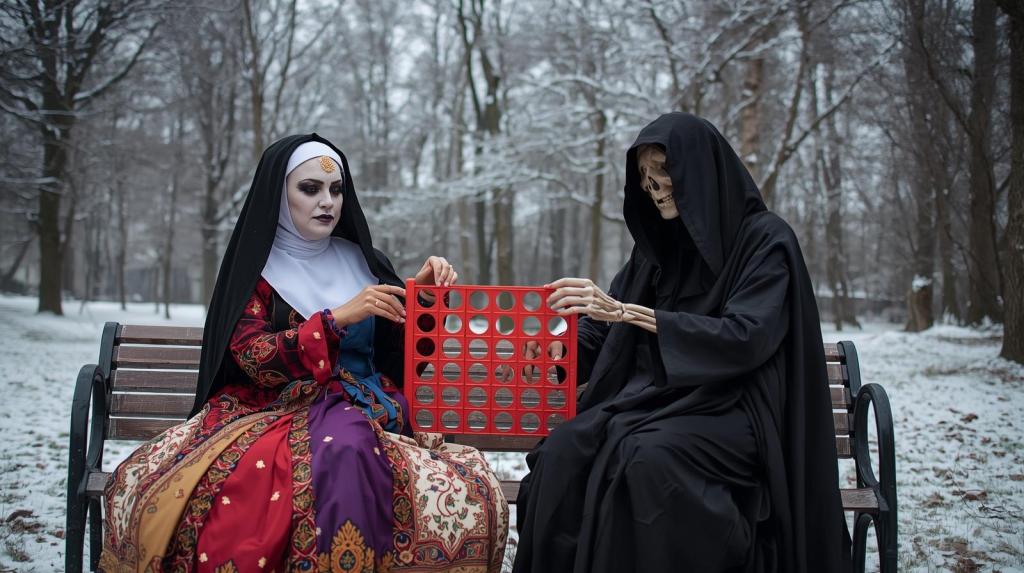
By Sister Organza Pettingfield
As humans living in the modern world, we are almost always unaware that we live our entire lives in the shadow of death. We are a delicate species. Easily killed. If we are exposed to too much heat or too much cold – we die. If we go too long without food or without water – we die. If we are struck too hard, or fall from too great a height – we die. If we eat the wrong food, or get stung or bitten by the wrong animal – we die. If we get sick with the wrong bacteria or virus – we die. If we take the wrong dosage or type of medication – we die. If our nation goes to war and we are called to serve or if we go to school with angry, vindictive schoolmates – we die. If we spend our lives in poverty and have inadequate access to the bare necessities for a decent, dignified life – we die. But we spend our lives entertaining ourselves with nonsense. Who’s in or who’s out. What’s in or what’s out. Gossip. Other people’s problems. Other people’s private lives. Other people. Anything to distract us from our own mortality. I am not without understanding, as I am as culpable as any other.
In early October, my mother fell in her bathroom while brushing her teeth and was taken by ambulance to the hospital. I turned to my husband on the couch next to me and said simply, “This is it.”
My mother has been sick for quite some time. First, shattering her shoulder after an unfortunate fall eleven years ago. Then being diagnosed with stage-2 lung cancer and undergoing a lobectomy and remedial chemotherapy nine years ago. We had been anticipating celebrating the “all-clear” from her oncologist indicating that they had successfully cured her cancer when she began experiencing unusual symptoms three years ago. It started with vision changes, then word-finding problems, and then finally personality changes. Having had years of untreated anxiety and depression, all of her doctors and her family thought that this was a mental health problem. But as she got worse, her oncologist sent her for a CT scan where they found a new tumor that had been growing in the left hemisphere of her brain. This was a return of her metastatic lung cancer. Her all-clear would have to wait.
I never knew that. I never knew that when you have cancer of your lungs or your skin and it metastases in another part of your body, like your brain, you don’t have brain cancer, you have actual mutated lung cells growing in your brain. Yet another unique way life tries to kill us. My mother had lung cells growing in her brain and they did not belong there, so we had a world-class neurosurgeon remove the mass and a radio-oncologist treat the affected area with gamma-knife radiation. She came out of both in great shape and returned to her life with monthly MRIs to monitor any return of the cancer. She was stable for an entire year until a new mass was noted near the same place as her prior growth. So, the same treatment was recommended by all of her doctors and we proceeded with that treatment.
But this time was different. This time something wasn’t right. When she came out of her anesthetic haze, she showed significant cognitive decline. She didn’t know where she was, or why she was there. She became confused, depressed and -rightfully so- more angry. We were told that this would get better over time and when it didn’t, I immediately arranged for neurocognitive rehabilitation. While this did not get her back completely, it got her back mostly. Yet, she still slowly continued to decline. Thanksgiving 2024 she wandered to the neighbor’s house after cutting her foot. And that Christmas, my brother woke up to find my mother smiling broadly, sitting in her favorite chair with her hair and make-up done but wearing nothing more than her bra and summer-weight pajama bottoms. She was rushed to the hospital with a legitimate fear that she had had a stroke. But her CT scans were all clear. Nothing was wrong.
A psychiatrist sat down with us and suggested that she would likely need to be placed in a memory-care facility or another home that would be able to care for her. But I refused to believe that we were there yet. Her neuropsychologist agreed with me and she continued in neurocognitive rehab and she again improved. We still had a very nice Christmas. I wish I had known it was going to likely be the last normal holiday I would experience.
She was able to spend another spring and summer out of a nursing home, gardening and drawing as she had always loved. Her yard was even slated to be on the city garden walk, something she was so excited about and had worked so hard to achieve. We had planned on coming into town in August to help her host the hundreds of people who would be touring her yard. But then she began complaining of increased fatigue and had to remove her yard from the tour. It broke her heart. In September, she began experiencing numbness and tingling in her right hand and again went to the hospital with no indication for the loss of function apparent. A month later she was in the hospital and a month after that, a resident of a nursing home where my family spent our first Thanksgiving with her as a patient.
So this Christmas, I got the wonderful gift of making the decision of how to proceed with treatment. Do I opt for more surgery, radiation and chemo that could leave her sicker and subtract from whatever time she has left with her family, or do I seek mercy and bring in hospice so that her final months can be as happy and fulfilled as possible? Life is a cruel master. I live 300-miles away and cannot rush to her bedside to have these difficult conversations with her. When I have brought the issue up, as a hypothetical, she shut down and refused to speak about what she would want when her treatment options have run out. How would I respond? I would any of us respond if our loved one came to us and said, “By the way, if you should happen to find yourself dying, how would you like us to manage your care? And what do you think of cherry wood for your casket?”
Yet living in the valley of the shadow of death during the season of light has been less difficult than one might imagine. I have discovered that most people are terrified of death and even more terrified to discuss it, like ignoring the subject somehow prolongs one’s life. I have determined that I cannot approach death that way – not my own and not my mother’s. Death is not something we should fear, at least not in the way that we do. Death is as necessary and as miraculous and -dare I say it – as wonderful as birth. For births, we hold gender reveal parties, showers, and annual birthday parties filled with cake, and presents and a bizarre song that nobody likes yet we all continue to sing. For deaths, we try and ignore them. We speak in hushed tones. We avoid the topic. There is no cake. No creepy songs. No discounts at Texas Roadhouse. The difference, between birth and death is a negligible one. Death is the required antecedent to birth. One cannot be born unless somewhere, someone else dies. Death is life’s fuel. Nothing in existence today could be there without the death of something else. Trees depend on death and decay to nourish enormous root systems. Mushrooms thrive on death. Even a mountain range is there because what had been a flat continent had to give way for an out of control plate ramming into the side of it.
Our own lives begin with death. Two totally independent, living cells, combine, die and become something else entirely – namely – you…or your kid, or a niece. But what of death? What does it mean to die? What exactly is that process and what happens when that process is over? Science, for all that it can explain, cannot precisely explain what happens when we die. I’m not talking about the failing of our heart, or the dying of our brain. I mean what truly happens to us, the real us. The fact is that science does not know. Faith has moved in with what it believes is an answer. But even this, I think, falls desperately short of what truly is to come. We live in what appears to be a limitless universe. We are human and perceive very little of what there actually is. Do you think a universe as enormous, unfathomable and mysterious as the one that we inhabit, would just snuff out its own consciousness? As human-centric as this might sound, we ARE the reason that the universe exists. For without a created consciousness, the universe would be unaware of its own existence.
I am a Catholic, albeit a heretical one, but a Catholic nonetheless. When Moses asks God what His name is, God responds with “I Am that I Am.” Most people view the Bible as complete fiction, and frankly, a lot of it is. But that answer is beguiling. “I Am that I Am.” God then is what it means “to be.” God is existence and the answer to why there is something rather than nothing. So for me, as a Catholic, the mystery of the incarnation, which we only just celebrated, is not a mystery at all. Fr. Richard Rohr said that God becomes things that he loves. And this means humans as much as a star or an atom of helium, or a redwood.
I am not afraid of death. If I am right, and we, in some manner or effect, go on into whatever comes next, and the process of physical death is merely a transformation, like the shedding of a chrysalis, then what an exciting time that will be. But if I am wrong, it won’t matter. I will become a part of the limitless and rejoin the earth, and all of creation as an indistinct part of it all. In one instance, I am still aware of my contribution to the miraculous, and in the other, I simply am not. When my mother dies, and she will, like us all, she will either be released from her shell into what comes next or will become a part of the world she so dearly loved. Either way, she wins. Either way, we do too.
